
Why Cheap Online Bikes Cost You More in the Long Run 📉🚲
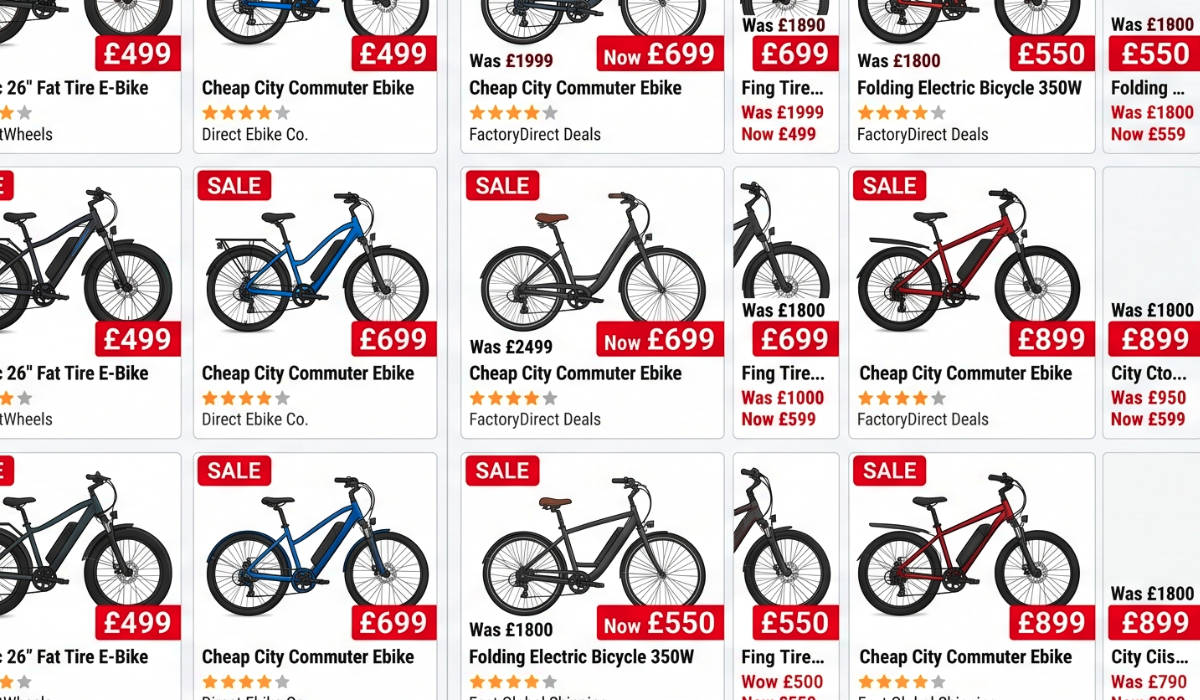
We see it all the time. A customer comes into the shop, looks at a quality £2,000 hybrid e-bike, and says, "But I can get one on Amazon or eBay for £500. Why are yours so expensive?"
Or even worse, we see customers who have spent £1,500 on an online e-bike that boasts basic branded gears, assuming they have bagged a premium bargain.
It is a completely fair question. On a screen, a generic e-bike looks suspiciously similar to a premium model from a reputable brand. They both have two wheels, a battery, and a motor. How different can they really be?
The answer is: completely different. And the differences usually become painfully obvious about three months after you click "Buy."
Here is the slightly geeky, uncomfortable truth about why budget online e-bikes are so cheap, and why they often end up being disposable purchases.
1. The Battery: A Matter of Safety, Not Just Range
This is the most critical difference. Reputable e-bike systems use high-grade lithium-ion cells that are heavily regulated by international safety standards.
More importantly, they feature sophisticated Battery Management Systems (BMS). The BMS is a computer inside the battery that constantly monitors temperature, voltage, and current across every single cell. If it detects an anomaly, it shuts the system down safely.
Cheap online e-bikes cut costs directly at the battery. They use unbranded cells and basic, rudimentary BMS boards. This is why you see warnings from UK fire services about e-bike battery fires. A cheap battery degrades faster, loses its charge capacity rapidly, and in the worst-case scenario, poses a genuine fire risk when charging.
2. The £1,500 Trap and "Unfixable" Parts
Let us address the mid-tier online bikes. You might find a £1,500 "no-brand" e-bike online that actually uses some lower-end Shimano gears. On the surface, it looks like a quality machine. However, the motor and battery systems are almost always the exact same low-quality, unbranded units found on the £500 bikes.
When an electronic part fails on these generic systems, you have a major problem. There is no diagnostic software and no spare parts catalogue. The factory that made the controller board last year has likely changed its specs or vanished entirely. No replacement parts means your bike becomes a very heavy, unrideable paperweight.
To understand the build quality of generic online bikes, let us share a true story from our workshop. A few years ago, a customer brought in a Chinese import e-bike they had bought online for £800. It just needed a new inner tube for a rear puncture. However, we could not get the rear wheel out. Why? The axle in the rear wheel was an integral part of the rear triangle. There were no bolts; it was just secured with big blobs of weld! For the sake of a £3.50 inner tube, that £800 bike was completely written off.
Granted, a welded-in wheel is an extreme example, but it perfectly highlights the wider issue. We regularly see no-brand e-bikes rendered entirely useless for the sake of a small electronic or mechanical part that simply is not available.
3. The Insurance Reality: Commercial and Home
Due to the very real media reports and fire risks associated with cheap e-bike batteries, the insurance industry has had to crack down hard. And this affects both bike shops and bike owners.
First, let us look at commercial bike shop insurance. Today, many policies for bike workshops explicitly state what kind of e-bikes the mechanics are allowed to have on the premises. For the vast majority of reputable shops, this means they are only insured to work on recognised, high-end systems (like Yamaha, Bosch, Shimano, Avinox, etc.) that are completely unmodified. No illegally chipped bikes, no DIY conversion kits, and absolutely no unbranded, poor-quality systems.
There may be shops or mobile mechanics out there who will still agree to work on them, but if they do, there is a very high chance they are operating uninsured. If something goes wrong, or a battery incident occurs while your bike is in their care, you could lose your bike entirely with zero protection.
But it goes further than the bike shop. You need to consider your own home insurance. Insurers are becoming acutely aware of the fire hazards posed by uncertified, cheap lithium-ion batteries charging in residential hallways and garages. Storing or charging a generic, no-brand e-bike could potentially invalidate your home insurance policy if an electrical fire were to break out. When you buy a certified bike from a reputable brand, you are buying peace of mind that it meets the rigorous safety standards your insurer expects.
4. The Warranty Ghost Town
If your motor stops working on a bike made by a reputable manufacturer, bought from an equally reputable local retailer, the process is simple. You go back to the shop to handle the warranty, they talk to the manufacturer, and they fix it.
If your generic online bike breaks within its so-called warranty period, the customer service process is usually a nightmare. You will likely find yourself emailing a generic address in another time zone, being asked to diagnose complex electrical faults yourself, and waiting months for parts that may never actually arrive.
The Takeaway: Buy Cheap, Buy Twice
An RRP £500 to £1,500 generic e-bike that lasts six months before an unfixable electronic failure is a terrible investment. A quality e-bike that lasts ten years with regular servicing provides a vastly safer, more enjoyable, and ultimately cheaper ride over its lifespan.
We completely understand that a quality e-bike is a big purchase. But buying a generic online e-bike isn't a bargain; it is a massive gamble.
If you are curious about what a proper, reliable e-bike feels like, have a browse through our digital showroom. We only stock bikes with electronics we trust, components that last, and warranties that actually mean something.